
Why Concrete Contractors Are Adding Microcement Services
While concrete remains a timeless design choice, more contractors are expanding their service offering to include microcement.
Microcement has become one of the fastest-growing surface finishes for residential and commercial projects. For concrete contractors in the US, it represents an opportunity to access new markets and offer solutions that concrete simply cannot achieve.
What Is Microcement?
Microcement is a thin surface coating, troweled by hand at over prepared substrates. It creates a seamless finish on floors, walls, ceilings, and joinery in both internal and external spaces — whether it’s bathrooms, kitchen countertops, or building facades.
Unlike traditional concrete slabs, microcement does not require the demolition and replacement of existing surfaces. Its ultra-thin application allows it to be installed over many properly prepared substrates, making it a popular choice for renovations where minimizing downtime, labor costs and construction waste is a priority.
Every formula has different modifications; SEMCO X-Bond is polymer-modified, meaning it contains advanced molecular technology that enhances adhesion, flexibility, crack resistance and durability. This allows the system to bond to a wide range of properly prepared substrates while helping accommodate minor substrate movement that would typically cause rigid cement-based finishes to fail.
Learn More: The Science Behind Microcement Durability

X-Bond Microcement Walls & Ceiling
Decorative Concrete vs Microcement: What's the Difference?
Although microcement systems can create a concrete-inspired aesthetic, there are key differences in the purpose and application of the two materials.
| Decorative Concrete | Microcement |
|---|---|
| Typically applied at greater thicknesses | Ultra-thin, typically approx 1/8” thick |
| Primarily used on floors and exterior surfaces | Suitable for floors, walls, ceilings, showers, joinery and more |
| Poured as a slab, so requires demolition or substrate removal in renovations | Can be installed over existing surfaces including tiles, old concrete, plaster, and more |
| Often focused on structural or flooring applications | An architectural finish system |
| Not generally used as a waterproof finish in showers or wet areas | Can be installed with approved waterproofing membranes and sealers, making it suitable for wet areas |
| May require joints depending on installation | Seamless, joint-free appearance |
For contractors, microcement is not necessarily a replacement for decorative concrete, but an additional service that fills gaps where traditional concrete systems are impractical.
For example, a client may want the appearance of concrete on bathroom walls, a shower enclosure or existing tiled surfaces. These projects would be difficult or impossible using conventional concrete slabs but are ideal for microcement.
Related Reading: Comparing Microcement to Other Surfaces
Access New Revenue Streams
Many concrete contractors primarily focus on:
Garage floors
Patios
Driveways
Commercial slabs
Concrete demolition & resurfacing
Microcement opens the door to entirely new project categories, including:
Feature walls
Retail fit-outs
Custom joinery and furniture
Kitchen renovations
These projects often carry higher perceived value and allow contractors to diversify beyond traditional flooring work.
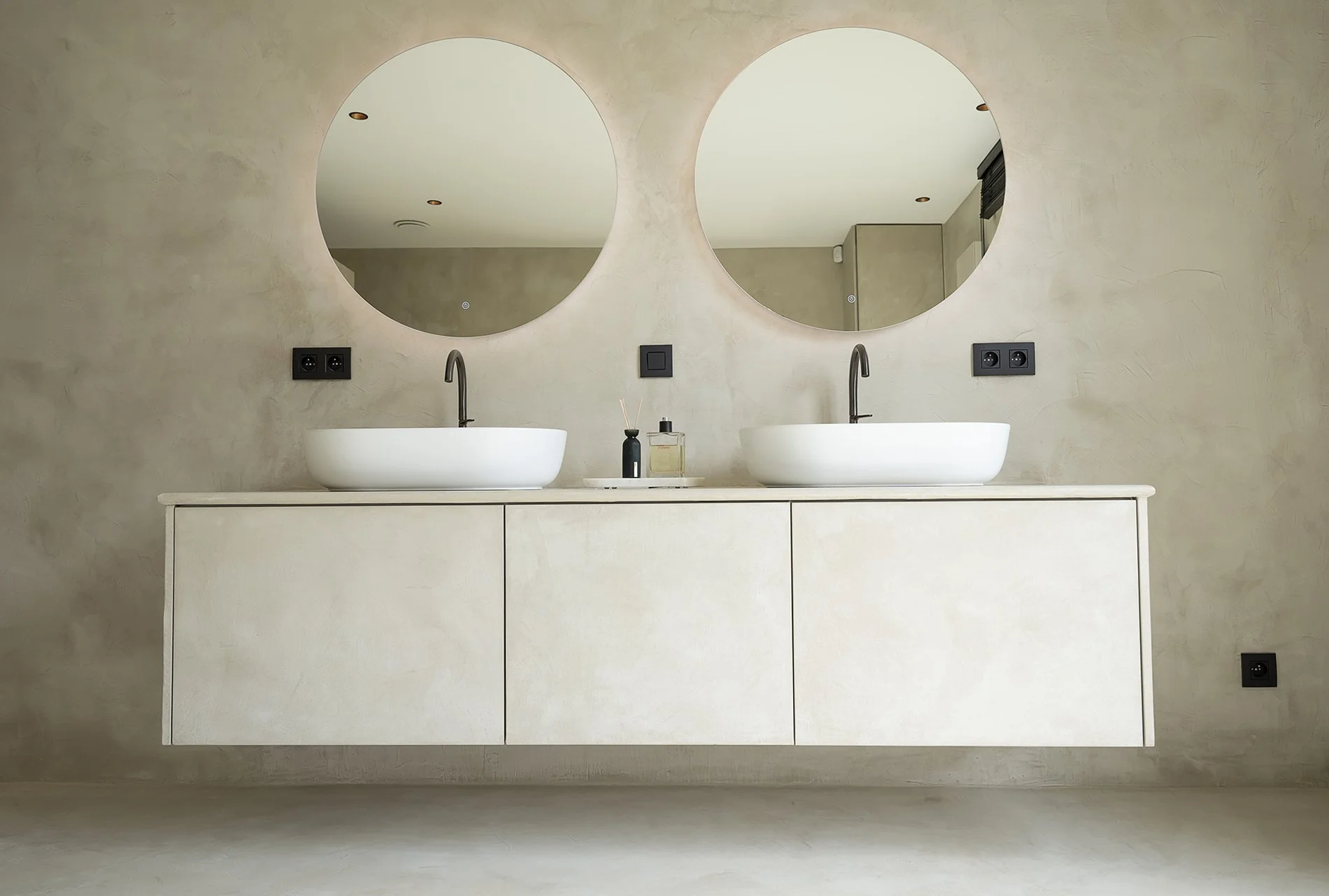
X-Bond Microcement Bathroom
Meet Growing Architectural Demand
Contemporary architecture increasingly favours seamless finishes and natural textures.
Designers are moving away from heavily patterned surfaces and grout lines in favour of minimalist materials that create continuity throughout a space.
Microcement allows contractors to deliver:
Seamless floors and walls
Continuous indoor-outdoor transitions
Modern concrete aesthetics
Wider range of colors and textures
As demand grows, contractors who can offer these finishes gain a competitive advantage over those limited to traditional concrete systems.
Install Over Existing Surfaces
One of the biggest advantages of microcement is its ability to be applied over many existing substrates.
SEMCO X-Bond Microcement was engineered for Remodel Without Removal, and is often installed over:
Existing tiles
Cement board
Drywall
Existing plaster, render or paint
MDF and joinery surfaces
This reduces demolition costs and project downtime while providing clients with a premium finish.

X-Bond Microcement Patio Flooring
Expand Into Bathrooms
Traditional concrete is generally not used inside showers or on waterproof bathroom walls. Microcement systems that are designed and certified for wet areas allow contractors to expand into bathrooms, showers, steam rooms, pools, and spa facilities.
This significantly broadens the range of projects that can be offered to existing clients.

X-Bond Microcement Shower
Future-Proof Your Business
The decorative finishes market continues to evolve alongside architectural trends. Contractors who embrace new systems position themselves to capture emerging opportunities and meet changing client expectations.
Adding microcement to your service offering doesn't mean abandoning concrete. Instead, it allows you to offer a broader range of solutions and tackle projects that would otherwise be out of reach.
For contractors looking to diversify and stay ahead of industry trends, microcement represents a natural next step in the evolution of decorative surface finishing.
Interested in Offering Microcement?
X-Bond is a professional-grade microcement system trusted by contractors, architects and designers across the United States for 30 years. SEMCO Surfaces provides concrete contractors and other trades professionals with a versatile solution for modern finishes.
Speak with our team about becoming an X-Bond installer and supplying microcement solutions in your market.