
Microcement for Exterior Walls, Masonry and Facades
Brickwork, concrete block, poured concrete and traditional render all have distinct characteristics. Some are deliberately exposed as part of a building's architecture, while others are simply the construction materials behind the finished facade.
When renovating an existing building, these materials don't necessarily need to dictate its future appearance.
Microcement introduces another possibility: retaining suitable existing masonry while changing the texture, color and visual continuity of the exterior.
But exterior resurfacing involves more than choosing a finish. The way a wall is constructed, how it manages moisture, and whether it moves or develops cracks will all influence how a microcement system should be specified.
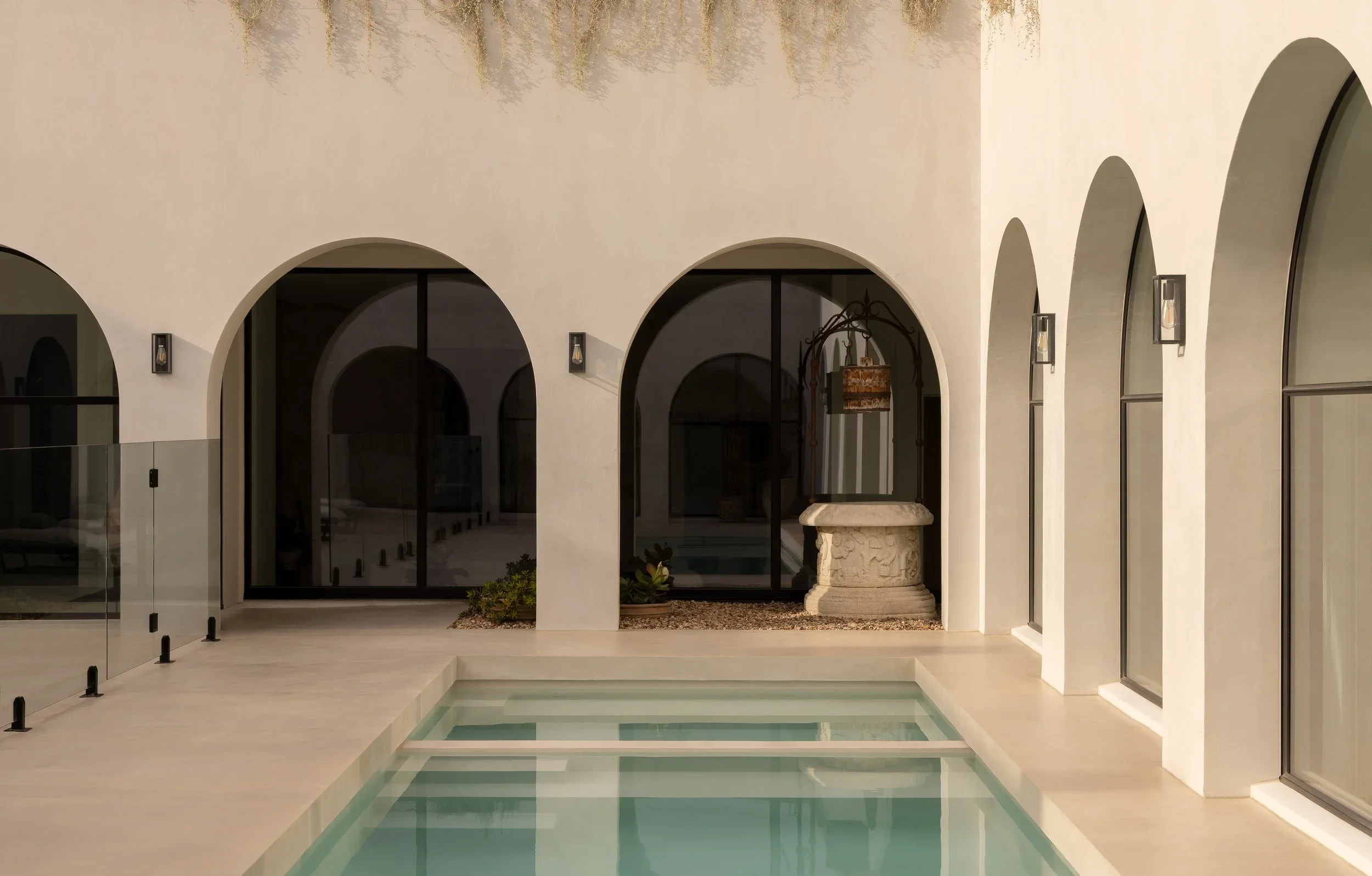
X-Bond Microcement Exterior Walls
Understanding Exterior Masonry Surfaces
Masonry is widely used to construct building walls, but the structural material isn't always what we see on the outside of a house.
Concrete block walls, for example, are commonly finished with stucco, render or other protective coatings. Poured concrete may be left exposed or finished, while brickwork is often deliberately visible as part of the building's architectural character.
This distinction matters when considering microcement for an exterior renovation.
Applying microcement over exposed brick presents different preparation requirements from resurfacing an existing stucco facade or applying a finish to concrete masonry units (CMUs).
In some cases, the existing exterior finish may provide a suitable base for resurfacing. In others, deteriorated coatings, damaged render or uneven masonry may require additional preparation before microcement can be applied.
Resurfacing Brick Facades
Brick is one of the most recognizable exterior materials in American residential architecture, particularly in older homes and commercial buildings.
While exposed brick can be worth preserving, there are situations where the existing brickwork doesn't suit the direction of a renovation.
Microcement can be used to achieve a modern, seamless finish that’s still durable enough to withstand exterior conditions.
However, brickwork is not a completely uniform substrate. Mortar joints create recesses, individual bricks can vary in porosity, and older masonry may contain residual moisture or salts. These conditions need to be evaluated before resurfacing.
Preparation may involve repairing damaged mortar, addressing uneven areas and establishing a suitable base over the brick before the decorative microcement layers are applied.
One particularly important consideration is how the brick wall manages moisture. Older solid masonry walls and modern brick veneer systems can behave quite differently. Some rely on the ability to release absorbed moisture, while others incorporate cavities, drainage paths and flashing. Applying a new exterior finish should never interfere with these functions.
This is why a brick facade needs to be assessed as an entire wall assembly, rather than simply treated as a surface ready to be coated.
Learn more about microcement resurfacing.
Concrete Block and CMU Facades
Concrete masonry units are widely used throughout the United States in residential, commercial and industrial construction.
In states such as Florida, CMU construction is especially familiar, with concrete block commonly forming the structural walls of homes and commercial properties.
Although the blocks themselves are practical construction materials, their exposed appearance isn't always desirable.
For renovations seeking a more refined exterior, microcement can provide a continuous decorative finish over appropriately prepared CMU surfaces.
There are, however, several considerations specific to blockwork.
Mortar Joints and Surface Uniformity
CMU walls are assembled from individual units separated by mortar joints. These joints can have different surface characteristics from the blocks themselves.
If the wall isn't properly prepared, variations in the underlying substrate may become visible through a thin decorative finish.
A suitable preparation system, for example using the microcement system components to build up a level base, helps establish a more consistent substrate for the microcement application.
Cracks and Movement
Concrete block walls can develop cracks due to settlement, thermal movement, moisture changes or other structural conditions. These cracks need to be assessed before resurfacing.
Although X-Bond is polymer-modified to improve adhesion and flexibility, it isn't intended to bridge ongoing structural movement or permanently conceal active cracks. Movement joints must also be accommodated in the finished assembly.
Moisture Exposure
CMU is porous, and exterior walls can be exposed to moisture from rainfall, ground conditions and other sources. Any existing water intrusion or dampness needs to be investigated and resolved before a new finish is installed.
Learn more in our microcement waterproofing guide.
Poured Concrete and Existing Render
Where existing concrete or render is stable and compatible, resurfacing is easy as these materials provide a relatively continuous finish without the mortar joints associated with unit masonry.
For existing render, key considerations include its adhesion to the underlying substrate and any signs of moisture damage. Even where the surface appears sound, areas of poor adhesion beneath the render may compromise the performance of a new overlay.
For concrete surfaces, it's important to assess any active structural movement, cracking or surface damage before applying microcement. These issues must be addressed during preparation to ensure a stable, suitable base for the new finish.
Color, Texture and the Character of an Exterior
The appearance of a microcement facade is influenced by more than the selected color. Surface texture, application technique, natural light and the building's geometry all affect the final result.
On a large exterior wall, subtle variations in a hand-applied finish can become more apparent as sunlight moves across the building throughout the day.
A lightly textured neutral finish might appear almost uniform in direct light, while low-angle sunlight reveals greater depth and surface movement.
This is one reason microcement works particularly well alongside materials with a strong natural character. Timber screening, metal window frames, exposed stone and architectural concrete can all provide contrast without introducing competing patterns across the facade.
For large exterior projects, sample panels are particularly valuable. They allow the design team to assess the intended color and texture under actual site lighting conditions before committing to the full application.
Read Next: A Guide to the X-Bond Finishes
Specifying X-Bond for Exterior Masonry
X-Bond Microcement is our innovative formula made using natural stone and a liquid latex polymer. The polymer component contributes to adhesion and flexibility, while the mineral components provide hardness and abrasion resistance. X-Bond is frequently specified in exterior applications because it has:
UV stability: Designed to withstand prolonged sun exposure without significant discoloration or degradation.
Minimal weight and bulk: Applied at approximately 1/8 inch thick, adding very little weight or thickness to existing walls and facades.
A durable, low-maintenance finish: When correctly installed and sealed, X-Bond creates a hard-wearing surface that can withstand everyday environmental exposure with minimal upkeep.
Enhanced adhesion: Its polymer-modified formulation promotes adhesion to a range of compatible masonry and cementitious substrates.
Improved flexibility: The liquid latex polymer helps reduce brittleness compared with traditional cementitious materials, although it should not be subjected to significant structural movement.
Seamless application: Creates a continuous architectural finish across suitable wall surfaces, corners and returns, without the regular joints associated with tiled or panelled cladding.
Design versatility: Offers a range of colors and hand-applied textures, allowing the finish to complement different architectural styles.
Note that for resurfacing projects, the suitability of X-Bond depends on the condition of the substrate and the complete installation system. Before specifying an application over exterior masonry, several questions need to be answered:
Is the existing masonry structurally stable and properly bonded?
Are there active cracks, movement joints or signs of settlement?
How does the wall currently manage moisture and drainage?
These considerations are especially relevant for facade renovations, where the existing wall may have been constructed decades before the proposed resurfacing work. The objective isn't simply to achieve adhesion on the day of installation. It's to ensure the new finish is compatible with the wall's ongoing performance. Find more information in our guide to preparing substrates for microcement.
Rethinking Existing Masonry
Exterior renovation doesn't always require replacing the materials that give a building its structure. Sometimes the most effective architectural change comes from reconsidering how those materials are finished.
An exposed CMU wall can become a refined, continuous surface. Mismatched brickwork can be visually unified. Existing concrete and rendered facades can take on an entirely different architectural character.
Microcement offers a way to make these changes while retaining suitable underlying materials. For contractors and designers, this is a game changer.